
A new report from Oxford Economics, titled "The Global Value of LEO Satellite Broadband Services" and commissioned by Amazon, finds that low Earth orbit (LEO) satellite broadband could generate an additional £2 billion in UK economic output and support more than 24,000 jobs by 2035.
Despite the UK's strong digital infrastructure, connectivity gaps persist. While 97% of UK premises can access superfast broadband, rural areas lag behind—just 62% of rural premises have gigabit-capable broadband, compared with 91% in urban areas. And around 1.9 million UK households found it difficult to afford fixed broadband in October 2024, according to Ofcom.
The research explores how LEO satellite broadband could help bridge connectivity gaps, both in the UK and around the world.
“LEO satellite broadband has the potential to become an important complement to terrestrial networks by extending internet access to communities that have long been underserved by traditional infrastructure,” said Henry Worthington, Managing Director at Oxford Economics. “Our analysis shows that, under the right conditions, wider adoption could generate substantial economic benefits by improving productivity, supporting digital inclusion, and helping more people and businesses participate in the digital economy.”
Why the UK's digital divide still matters
The UK has made significant strides in expanding its digital infrastructure. The government's £5 billion Project Gigabit programme uses local and regional contracts, alongside the Gigabit Broadband Voucher Scheme, to subsidise high-speed rollouts in harder-to-reach areas. Complementing this, the Digital Inclusion Action Plan aims to ensure that high connectivity rates are matched by the digital skills people need to participate in the modern economy.
Yet challenges remain. Around 96% of the UK population are regular internet users, and the vast majority of homes (69%) have access to full-fibre broadband. But for communities in remote or rural parts of the country—from the Scottish Highlands to parts of Northern Ireland, where around 2,000 premises still can't access decent broadband—reliable, affordable connectivity isn't guaranteed.
This is where LEO satellite broadband could make a real difference.
What LEO satellite broadband could mean for the UK economy
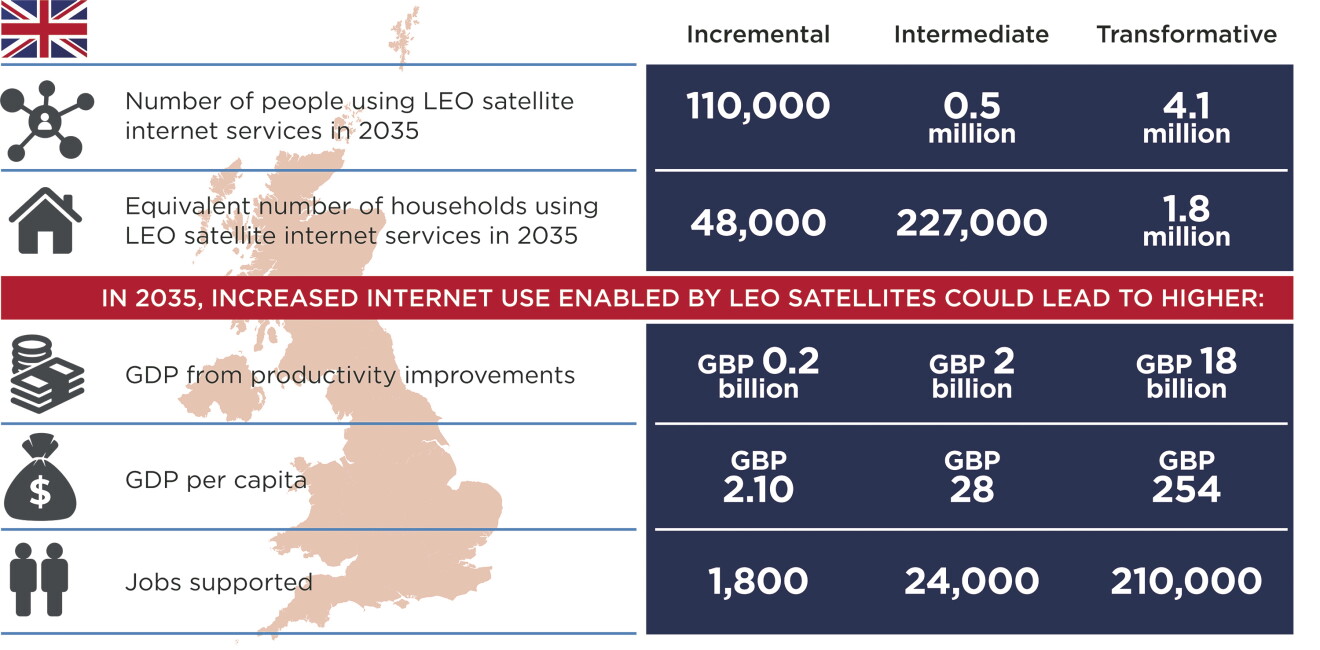
Oxford Economics modelled three scenarios reflecting different levels of LEO adoption, from limited take-up in unserved remote areas through to widespread adoption. In the UK, the report estimates:
- Incremental scenario: Around 110,000 people using LEO internet services by 2035.
- Intermediate scenario: Nearly 500,000 LEO users, generating an additional £2 billion in economic output and supporting more than 24,000 jobs.
- Transformative scenario: Up to 4.1 million LEO users, with even greater economic gains as the technology becomes more cost-competitive.
The productivity boost comes as businesses and households in underserved areas gain access to digital tools, e-commerce, remote working, and online services that were previously unreliable or unavailable.
What makes LEO satellite broadband different?
 Amazon Leo’s LE-02 mission launches from Europe’s Spaceport in French Guiana aboard an Arianespace Ariane 6 rocket. Photo by Arianespace
LEO satellites orbit roughly 60 times closer to Earth than traditional geostationary satellites, enabling high-speed, low-latency internet that can approach fibre-like performance. That makes the technology uniquely capable of reaching communities that terrestrial networks can't serve economically.
LEO connections are also space-based, meaning they're insulated from terrestrial outages and physical damage, making them critical for emergency resilience. And because subscribers can self-install a dish and modem without specialist engineers, deployment is faster and simpler than traditional infrastructure rollouts.
Unlocking opportunity for small businesses
Small and medium-sized businesses stand among the greatest potential beneficiaries of expanded LEO connectivity. The report identifies five key ways improved internet access drives economic growth, from enabling remote businesses to enter e-commerce and reach new customers, to lowering operational costs through digital communication and remote working, to opening doors to digital banking, skills development, and advanced technologies like AI.
Read the full Oxford Economics report, "The Global Value of LEO Satellite Broadband Services," here.
Stories we think you’ll like